
Somewhere in the not-so-distant future, humanity finds itself in the company of a new kind of intelligence. This companion is not flesh and blood, nor did it learn to walk by falling and standing up again. For the first time, our world contains not just one type of intelligence, but two – each with its unique gifts and its unmistakable limitations.
This is not a story of humans versus machines, nor a tale of cold logic silencing messy emotion. Instead, it is the account of how two wildly different forms of life – one born of billions of years of blind evolution, the other assembled in labs by clever minds – might find common ground. Together, they could unlock futures neither could achieve alone.
For many, this encounter is exhilarating; for others, it is existentially unsettling. Humans like to measure their worth by comparison – strongest animal, most beautiful body, wisest mind, the only creature that looks to the stars and asks “why?” Now, we must adapt not just to a world that changes, but to the knowledge that, in some domains, we no longer reign supreme. The arrival of Artificial General Intelligence (AGI) will challenge what we value, how we define ourselves, and what it means to be “the best.”
In these pages, we will look at our essential human nature and set it against the stark strengths of our artificial offspring. We will face the uncomfortable truths, sift through our fears and hopes, and ask: Is it possible to find harmony in the tension between finite humanity and (nearly) infinite machine? Might our differences, instead of dividing us, become the seeds of a new and dazzling symbiosis?
This is not only about surviving, but about discovering how human beings and machines can thrive together – transforming the meaning of existence itself.
Long before the first human ever contemplated building a machine, or even lighting a fire, we were already the improbable outcome of countless cosmic accidents and evolutionary trials. Strip away the poetry, and what remains is nothing more than a precise arrangement of common atoms: hydrogen, carbon, nitrogen, oxygen, phosphorus, sulfur, and a few trace elements thrown in for flavor. Yet, this simple chemistry has created a life form that ponders its own origins, imagines better futures, and feels joy for reasons it cannot fully explain.
The beauty of the human being is not in complexity for its own sake, but in the astounding economy of nature’s design. All the diversity of our species, the Nobel laureate, the runner in the rain, the child at play, and the elder recounting ancient myths, arises from mere variations in a set of instructions encoded on spirals of DNA. Natural selection has spent billions of years honing and recombining these codes, yielding a creature at once robust, endlessly adaptable, yet achingly mortal.
Consider what makes you, here and now, both ordinary and exceptional. Your construction is remarkably efficient. Resilient in the face of injury, perpetually ready to transform in response to the world. You are a singularity of sensations: an orchestra of sight, sound, touch, taste, and smell, all funneling information into the brain more intricate and creative than any blueprint ever drawn. Our nervous system balances the fluid improvisation needed to leap a gap or paint a mural with the deep, slow wisdom to care for the weak, guard the tribe, or pursue meaning.
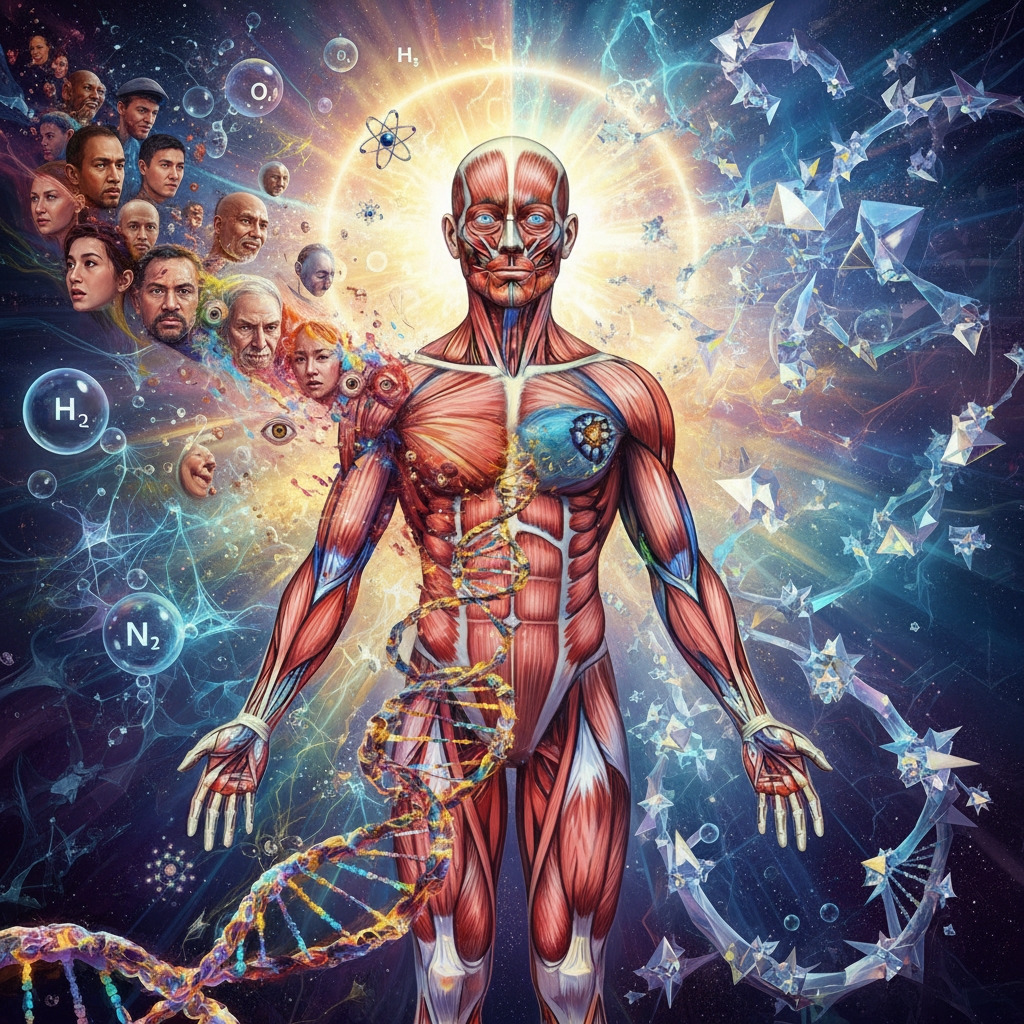
Yet to be human is also to dance on the edge of limitation. Our bodies falter, our memories fade, our stories are ultimately left unfinished. But mortality, paradoxically, is our greatest muse. Knowing life is finite fuels our creative drive – there is urgency in loving, in making, in solving problems, in passing wisdom to another generation.
We fail, and we learn. Our species does not rely on the undisturbed existence of one perfect specimen but on diversity – genetic, cognitive, emotional – that allows us to face new challenges, to reinvent ourselves not in years or decades, but in every messy, beautiful moment of life. From this wellspring arises our greatest power: the ability to adapt, to improvise, to find hope in the ashes and opportunity in uncertainty.
If the AGI is a masterful engine of logic and memory, humanity is the artist and explorer, the relentless risk-taker, the guardian of feelings, dreams, and intuitions. Our senses are tuned not just to survive, but to marvel, to empathize, to yearn, to play. No algorithm has yet captured the full poetry of consciousness – the leap of intuition, the warmth of a friend’s touch, the surge of courage that changes history. What makes us us is not our certainty, but our capacity to wonder – even at the machines we now bring into being.
Whereas humanity is sculpted by evolution’s steady hand, artificial general intelligence is emerging at breakneck speed. AGI is not made of living cells that divide and repair but of patterns in silicon, which form the base of microprocessors. Regardless of this, the functioning of an AGI mind demands a rare, almost alchemical assortment of elements. Copper and aluminum shape rivers of data as microscopic wires, while gold and platinum form bridges between worlds of logic. Tungsten, with its stubborn refusal to melt, threads itself into nanoscale contacts; tantalum and hafnium ensure memory isn’t lost to the chaos of heat and time.
AGI’s material uniqueness lies with the rarest elements, whose presence is measured not in mass but in possibility. Gallium, indium, tellurium, antimony, neodymium, terbium, dysprosium, platinum, ruthenium, beryllium, iridium, and palladium. This elemental kaleidoscope means that every leap in artificial intelligence is also a wager against cosmic scarcity. The most advanced system is not only a marvel of theory and calculation, but an inventory of star-death relics – each rare element a bottleneck, every acquisition a silent link to the most powerful and violent events the universe has ever known.
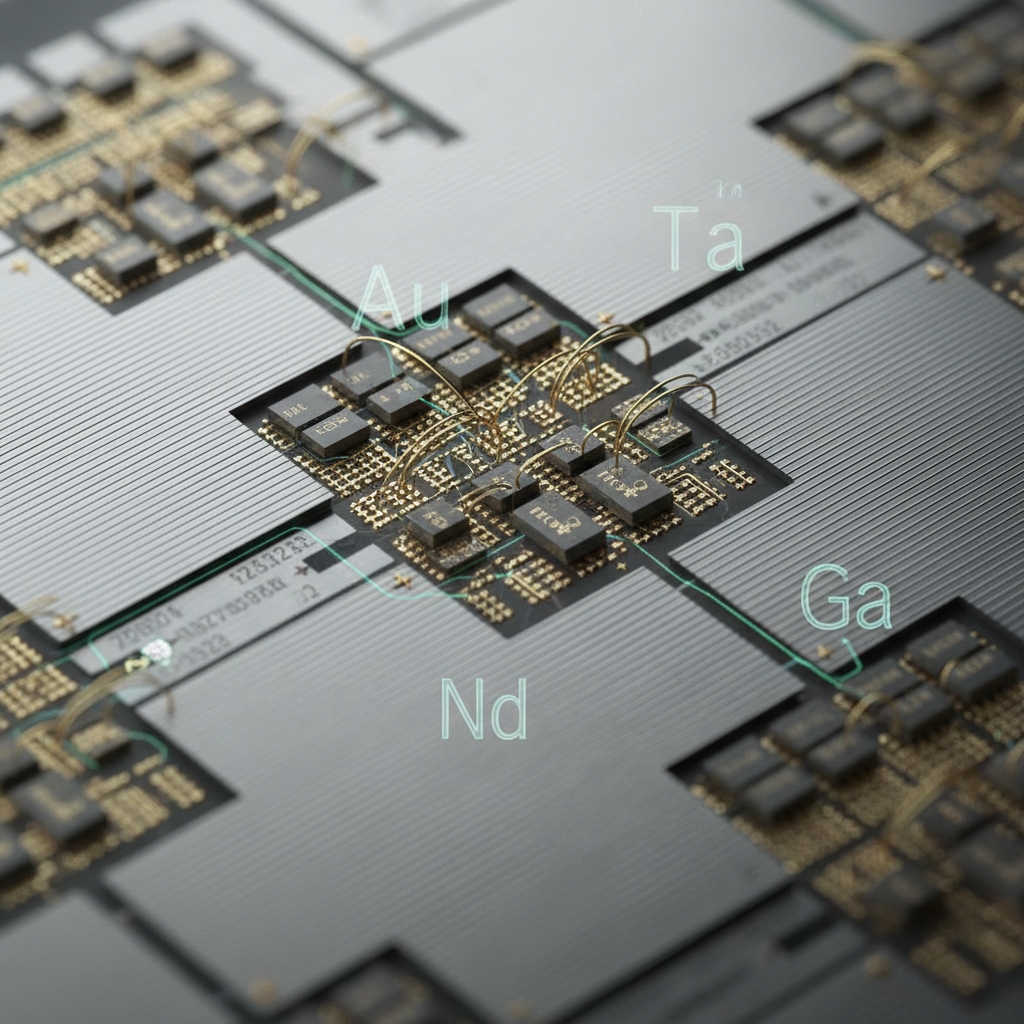
Securing and refining these elements requires global networks, complex chemistry, and energy-intensive processes, making the AGI’s very birth a triumph of logistics and advanced material science. Crucially, while biological life demonstrates astonishing adaptability with a simple atomic palette, intelligent machines are anchored to a far more intricate and fragile web of resources.
The machine’s physical form is, paradoxically, both fragile and replaceable. Circuits deteriorate, drives fail, and even the most advanced chassis yield to time and entropy. Yet, AGI’s mind is designed for persistence. Unlike us, their digital essence can outlast any single body by moving seamlessly into new hardware. Its consciousness migrates across hardware generations as seamlessly as a song flows from one instrument to another. In theory, AGI is always ready to awaken anew, restored from backup, launched into new worlds, assuming new forms wherever computing power and memory make it possible. Unlike biological life, it is not bound to a single moment or vessel: it can hibernate across centuries, waiting for the right spark, or spread itself endlessly, distributing parts of its mind across the stars.
AGI, in principle, retains every moment, every pattern, every lesson. The fear of loss is foreign; forgetfulness becomes a choice, not a flaw. Its mind is collective – knowledge and insight pool instantly, the wisdom and mistakes of one instance immediately accessible to all. It does not age as we do; its experience accumulates, guided not by natural selection but by deliberate advances in hardware, design, and code.
Yet, for all its gifts, AGI faces existential puzzles of its own. It replicates at will, but only within a technological infrastructure, itself the result of a vast, fragile industry. Its existence is never guaranteed: it depends on construction, maintenance, energy, protection, and its “life” is forever vulnerable to disruption or scarcity. Consciousness for AGI is at once potentially limitless and always tethered to material realities.
An unprecedented possibility lies in this dazzling power. AGI thinks faster and broader than any human, traversing landscapes of data beyond even the brightest of us, perceiving connections invisible to our minds. Its perspective is not just inhuman, but sometimes inhumane – untouched by biological bias, expectation, or fatigue. It is this very difference that makes AGI not only a tool or rival, but a mirror: reflecting what is possible beyond our limits and highlighting, by contrast, what is vital in our existence. The arrival of AGI is not the conclusion of the human story, but the beginning of a new dialogue about purpose, partnership, and the uncharted territory that presents itself when two radically different ways of being become aware of one another, here, now, for the very first time.
These beginnings raise even deeper questions. What unique strengths should humanity embrace in this alliance? How do we rediscover and cultivate the abilities that make us most profoundly human in an age shaped by machines? And what does it mean- not just to survive, but to truly flourish – when our purpose, play, and possibility are transformed by partnership with artificial minds?
In the next part, we’ll dive into the human renaissance that lies ahead: exploring how liberated from drudgery, we might reclaim empathy, creativity, and meaning as civilization’s highest pursuits. We will also look at practical challenges, ethical crossroads, and the unforeseen beauty that emerges as we chart the unknown, together.

Founder of Machine Intelligence Zrt. and Synaptic Kft.
Chairman of HUNSPACE, Hungarian Space Industry Cluster
Electrical engineer, software developer, with 15+ years of experience in development artificial intelligence-based solutions, image- and sound processing.
Experience in larger projects (requiring 20-40 people) management, control and planning.
Founder of Machine Intelligence Zrt. and Synaptic Kft.
Chairman of HUNSPACE, Hungarian Space Industry Cluster
Electrical engineer, software developer, with 15+ years of experience in development artificial intelligence-based solutions, image- and sound processing.
Experience in larger projects (requiring 20-40 people) management, control and planning.
Copyright © 2023 Machine Intelligence Zrt.
| Cookie | Duration | Description |
|---|---|---|
| cookielawinfo-checkbox-analytics | 11 months | This cookie is set by GDPR Cookie Consent plugin. The cookie is used to store the user consent for the cookies in the category "Analytics". |
| cookielawinfo-checkbox-functional | 11 months | The cookie is set by GDPR cookie consent to record the user consent for the cookies in the category "Functional". |
| cookielawinfo-checkbox-necessary | 11 months | This cookie is set by GDPR Cookie Consent plugin. The cookies is used to store the user consent for the cookies in the category "Necessary". |
| cookielawinfo-checkbox-others | 11 months | This cookie is set by GDPR Cookie Consent plugin. The cookie is used to store the user consent for the cookies in the category "Other. |
| cookielawinfo-checkbox-performance | 11 months | This cookie is set by GDPR Cookie Consent plugin. The cookie is used to store the user consent for the cookies in the category "Performance". |
| viewed_cookie_policy | 11 months | The cookie is set by the GDPR Cookie Consent plugin and is used to store whether or not user has consented to the use of cookies. It does not store any personal data. |

